
‘Anti-homelessness landscaping’ in Middlebury raises questions over approaches to rural encampments
Theo Wells-Spackman is a Report for America corps member who reports for VTDigger.
For Josh Simon, who lived outdoors in Middlebury for a time until finding a new place to stay last fall, a spot under the large concrete supports of the town’s Cross Street Bridge had been a frequent resting place.
A combination of relative quiet, shelter from the elements — bar the wind, he said — and the presence of others hanging out, smoking or watching the water there too made the site appealing.
“It was certainly helpful to people in our position, you know, that were outdoors and wanted some company,” said Simon, a 40-year-old who grew up in Hinesburg and other nearby towns. “There’s blue herons that come through there. It’s really quite nice.”
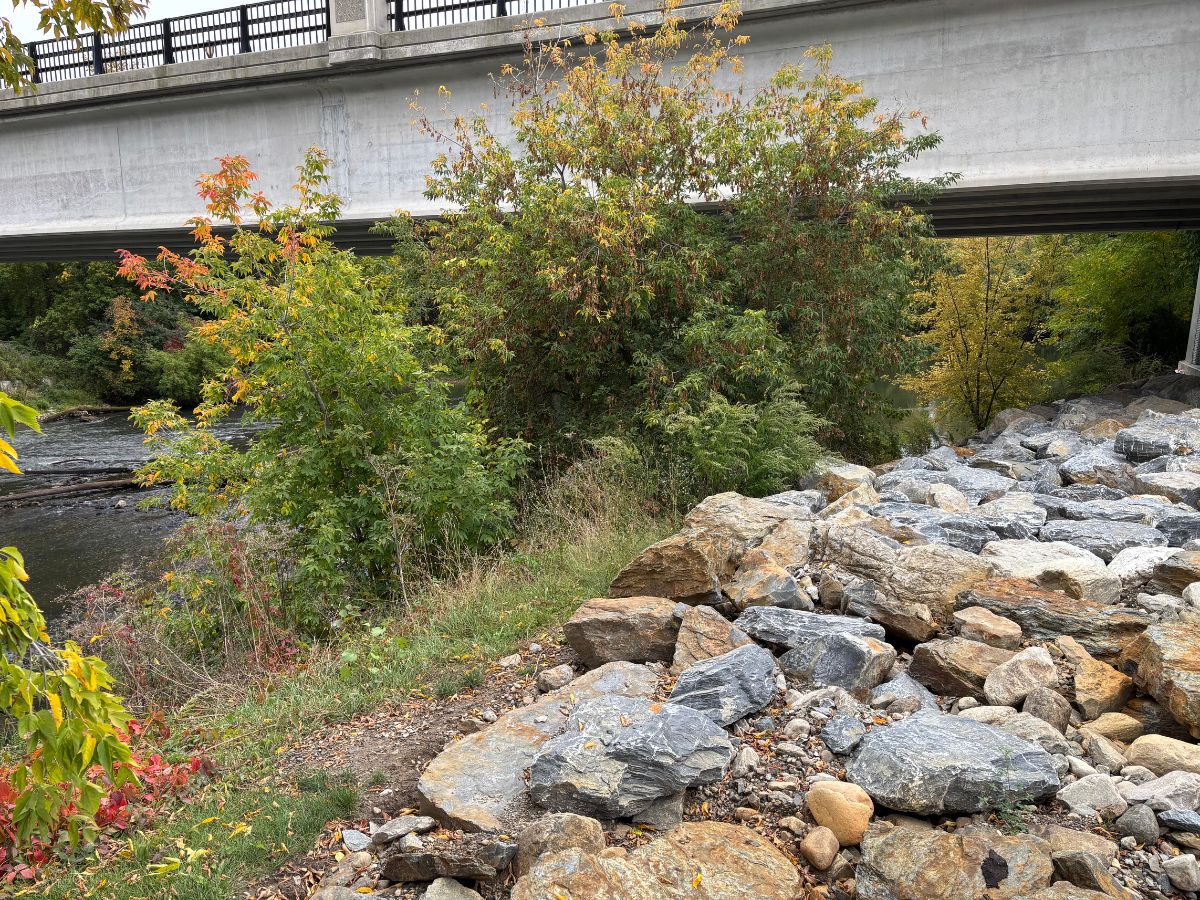
Now, the spot is uninhabitable by design.
This summer, town officials layered large, uneven rocks across the area where tents used to pop up, and built a new chain-link fence blocking a space where residents sometimes struck small fires. Town Manager Mark Pruhenski said the decision stemmed from public safety concerns for local residents and businesses.
The move has drawn a conflicted reaction from local service providers, who said affected unhoused residents often have nowhere else to turn. As cold weather approaches and debates rage in Montpelier over the state’s approach to homelessness, the small municipality faces a difficult balance between the competing needs of its constituents.
Town staff decided to move ahead with the landscaping move in July, Pruhenski said earlier this month, after a period in which the bridge had become “a really difficult area to manage.” Staff gave the small handful of residents several weeks’ notice of the change, he said, and tried to connect them with local service providers.
“We just didn’t see this situation ever ending again. It was a revolving door of tents coming in,” Pruhenski said in an interview.
It’s a prohibited location under the town’s encampment policy, he added, and activity in the area had elicited a number of complaints from adjacent businesses. But the town’s process for removing those living in tents from such a location is time-intensive, Pruhenski said, and the repeated need to do so had required significant resources and police time.
Rick Buck, who owns the nearby pub Mister Up’s, said customers reported being disturbed by the camp’s residents, and recalled reports of vandalism to cars in the adjacent parking lot several years ago. Those factors likely influenced traffic into the restaurant, he said.
Buck expressed support for the town’s approach to the problem, saying he only wished it had come sooner.
Simon said the town’s argument struck him as “completely reasonable.” But he knows that for others, the forced move was deeply upsetting.
READ MORE
“There could be a gentler solution,” Simon said, but “it’s not an easy problem.”
The behavior of a couple of individuals impacted the town’s approach to the whole group, he added.
“Problems are caused, and then everybody gets booted,” he said. “It’s kind of a thing that happens on repeat with homeless people.”
A number of Vermont towns have long struggled to address encampments, with Montpelier, Burlington and Middlebury all evicting gatherings of unhoused residents in recent years.
Middlebury area service providers agreed that the town faced a tricky situation, and said officials and local police have consistently approached the issue thoughtfully. But several expressed concern about the move’s impact on the area’s unhoused population.
“We keep moving people away from places and saying ‘get out, get out, get out,’ but where are they supposed to go?” said Jeanne Montross, who leads Helping Overcome Poverty’s Effects, a social services nonprofit in Middlebury.
Local shelters aren’t just full, according to Susan Whitmore, executive director of the nearby John Graham Shelter in Vergennes — they’re dramatically overflowing. Whitmore’s organization, which can hold nine households at a time, has a 23-household waitlist. Middlebury’s Charter House, which can house 25 people and did not respond to requests for comment, has a waitlist of 47 individuals, according to Whitmore.
Andy Hooper, who chairs the Middlebury Selectboard, called the landscaping decision effective in its purpose, but said whether or not he agrees with the move is a “very tough question.”
There’s a delicate balance between keeping vulnerable people as safe as possible and not creating such a hospitable environment that people with complex psychological or substance use treatment needs are drawn to the area from elsewhere, Hooper said. Fundamentally, he added, homelessness is “really hard to deal with at the municipal level.”
“And as the federal and state spigots are increasingly running thinner, I don’t know where those resources come from,” Hooper said. Advocates have criticized recent changes to Vermont’s homelessness response, including reduced emergency housing intake hours and changes to the program’s eligibility assessment process, as misguided and restrictive.
Montross is all too familiar with budgetary limitations. Her efforts last month to try and create a seasonal emergency shelter in Addison County fell through after it became clear that no local provider had sufficient resources to oversee the project, she said.
This kind of “anti-homelessness landscaping” can also cause unhoused people to settle in more dispersed, remote locations, according to state Rep. Jubilee McGill, D-Bridport, who sits on the House Human Services Committee and works at Addison County’s Peer Recovery Center. That can make it more difficult to connect them with services, she said.
Simon says he knows several small camps which have sprung up in hidden or remote areas of town, including in the woods.
Several former residents of the bridge encampment have gone north to Burlington, according to Trevor Burton, who conducts regular street outreach in Middlebury with McGill’s organization. He hasn’t seen a third in several months, he said.
Burton said his work has become harder as the town’s unhoused population becomes more dispersed. He’s also worried about how people will fare without assistance as harsh weather draws closer. He doesn’t feel that he can direct people to any specific place in town where they are allowed to camp, he added.
“It’s really just pushing people further out of town,” Burton said of Middlebury’s approach to its unhoused population.
Read the story on VTDigger here: ‘Anti-homelessness landscaping’ in Middlebury raises questions over approaches to rural encampments.
Courtesy of VT Digger
Keywords
Addison County, Champlain Valley, Regional, homeless encampment, homelessness, Middlebury


