
Judge denies attempt by Trump’s DOJ to exclude 20,000 California ballots from vote count
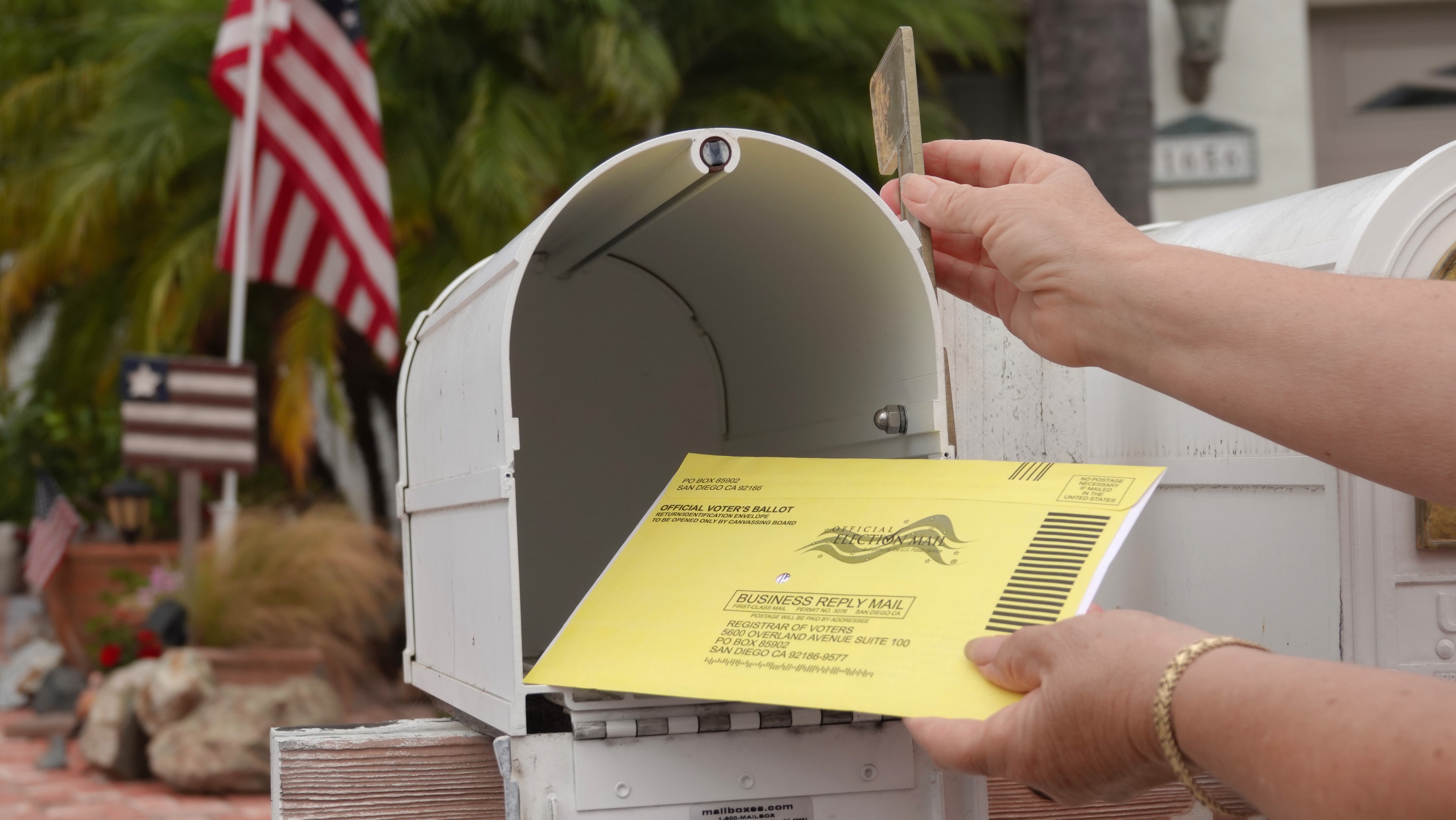
President Donald Trump’s administration is attempting to assert authority over state-run elections in the final days before voting ends in the midterm elections. (Photo by Simone Hogan/Getty Images)
A federal judge on Wednesday denied a U.S. Department of Justice request that would have forced California to not count the ballots of 20,000 voters the Trump administration alleges are likely noncitizens.
The decision sets the case on a course to possibly reach the U.S. Supreme Court within days.
In a scathing decision, Judge David Carter ruled that President Donald Trump’s administration was seeking to coerce California to abandon its constitutional elections procedures and “bend to the will of the Executive Branch” — a situation the veteran judge called unprecedented.
Carter, an appointee of President Bill Clinton in U.S. District Court for the Central District of California, denounced the Justice Department’s lawsuit in strong terms as a threat to the ability of more than 20,000 California residents to vote. He warned the DOJ’s request would create chaos less than a week from Election Day.
“In bringing this lawsuit, the Executive would have this Court believe that it reigns as a sole sovereign. But California and its people are sovereign, too,” Carter wrote.
Suits in California, Alaska
The Trump administration is mounting an aggressive legal campaign to assert authority over state-run elections in the final days before voting ends in the midterm elections. In addition to California, the Justice Department has also preemptively sued Alaska over the certification of its U.S. Senate race.
If the California lawsuit reaches the Supreme Court, an opinion that keeps alive the Justice Department effort there could encourage the Trump administration to use the same tactic in more states. On the other hand, a forceful ruling against the department could thwart any nationwide strategy to force states to set aside ballots.
The Justice Department this month provided California election officials with a list of approximately 20,000 individuals that it said were likely noncitizens registered to vote in the state. The DOJ demanded California segregate the ballots of those on the list and not count them unless they could prove their citizenship — citing a federal misdemeanor crime against noncitizen voting.
The DOJ says the U.S. Department of Homeland Security compiled the list after obtaining a public copy of California’s voter roll and checking it against government records and information from the LexisNexis research service. Officials in California and Los Angeles County have questioned the list’s accuracy and warned against relying on it to prevent the tabulation of ballots.
The U.S. Constitution assigns states the responsibility of administering elections. Congress can override state rules and regulations, but the executive branch has no unilateral power to intervene absent authority from Congress.
‘Quiet period’ cited
Carter wrote that the Justice Department’s request violates longstanding constitutional principles mandating that states control their own elections. He also noted that the DOJ had sent California the list of 20,000 voters during a 90-day “quiet period” ahead of federal elections when election officials are prohibiting conducting mass purges of registered voters.
The Justice Department’s actions point to a “broad, ongoing pattern of attempted election interference by federal officials,” the judge wrote. Its request likely violates both the National Voter Registration Act and the Civil Rights Act, he wrote.
The Justice Department has a “clear remedy,” Carter wrote — it can prosecute alleged noncitizen voting.
“Eroded trust in our democracy is irreparable,” Carter wrote. “Once a vote is segregated, lasting harm has occurred. If the Executive can discount votes and threaten an ongoing election due to unproven allegations, then our democracy is in danger.”
Appeal expected
In the wake of Carter’s decision, the Justice Department will likely appeal to the 9th U.S. Circuit Court of Appeals. A three-judge panel already denied an emergency request from DOJ on procedural grounds, but two of the judges also expressed opposition on the merits — a strong signal the department will probably lose again.
The 9th Circuit’s decision, assuming the appeals court again rules quickly, will set the stage for a final appeal to the Supreme Court.
The Justice Department didn’t immediately respond to a request for comment on Carter’s ruling.
The judge’s order came a day after an hours-long hearing in Los Angeles where Bill Essayli, the first assistant U.S. attorney for the Central District of California, argued that California was required to take action after officials were provided with evidence of likely noncitizen voters.
“What they cannot do is nothing and proceed to count the votes,” Essayli said.
Essayli said election workers could face “criminal liability” if they tabulate the ballots of suspected noncitizens — drawing a rebuke from Carter, who urged the Justice Department to drop any “threats” against state and local officials.
Carter wrote that the Justice Department had previously sent letters to election officials in California saying that they risked significant federal scrutiny if they refused the DOJ’s demands.
“The government reiterated its threat in open court yesterday,” Carter wrote, adding that “these threats must stop.”
California Secretary of State Shirley Weber, a Democrat, and Los Angeles County Registrar-Recorder/County Clerk Dean Logan have warned that segregating ballots would be logistically impossible. Complying with the DOJ’s demands would effectively derail the election and push ballot counting past a statewide Dec. 3 deadline to certify results, they said.
But beyond the practical consequences, Weber and Logan’s lawyers have argued that the Justice Department is seeking to encroach on the state’s authority over elections.
“Their legal claim is simply not serious,” Michael Cohen, a lawyer for Weber, said.
Courtesy of D.C. Bureau
Keywords
D.C. Bureau, Gov & Politics


